The Cannes Film Festival red carpet has always thrived on spectacle. For decades, celebrities and luxury fashion houses have treated the prestigious event as a global stage for couture experimentation, producing some of the most unforgettable and controversial style moments in pop culture history.
But in 2026, the conversation surrounding Cannes fashion noticeably shifted.
Following the festival’s updated red-carpet guidelines discouraging overly revealing sheer looks, exaggerated trains, and silhouettes that obstruct guest movement, many expected this year’s carpet to move toward more restrained glamour.
Instead, celebrities arrived in outfits that appeared to challenge the rules almost immediately.
While some stars embraced illusion fabrics, subtle transparency, and sculptural couture to work within the festival’s revised guidelines, others leaned fully into daring fashion choices featuring visible breasts, bare looks, dramatic trains, and silhouettes that left little to the imagination.
Several celebrities appeared to intentionally test how strictly Cannes would enforce its updated standards, arriving in illusion mesh ensembles that hinted at n*dity while technically remaining covered, alongside exaggerated gowns and sweeping trains that pushed the boundaries of the festival’s new “efficiency” rules.
At the same time, some of the festival’s most talked-about looks relied less on couture craftsmanship and more on direct exposure, reigniting conversations about where Cannes draws the line between artistic fashion, calculated provocation, and outright dress-code violations.
Here are the Cannes 2026 boundary-pushing looks that came closest to testing the festival’s strict “decency and efficiency” dress code.
#1 Bella Hadid
The internationally recognized supermodel attended Cannes 2026 as a major ambassador for Prada, Chopard, and her fragrance line Ôrəbella, dominating the Croisette with a carefully curated mix of vintage references, archival glamour, and custom haute couture.
For the premiere of La Bataille de Gaulle, Bella Hadid wore a custom ivory Schiaparelli Haute Couture gown designed by Daniel Roseberry that paid direct
#18 Lady Victoria
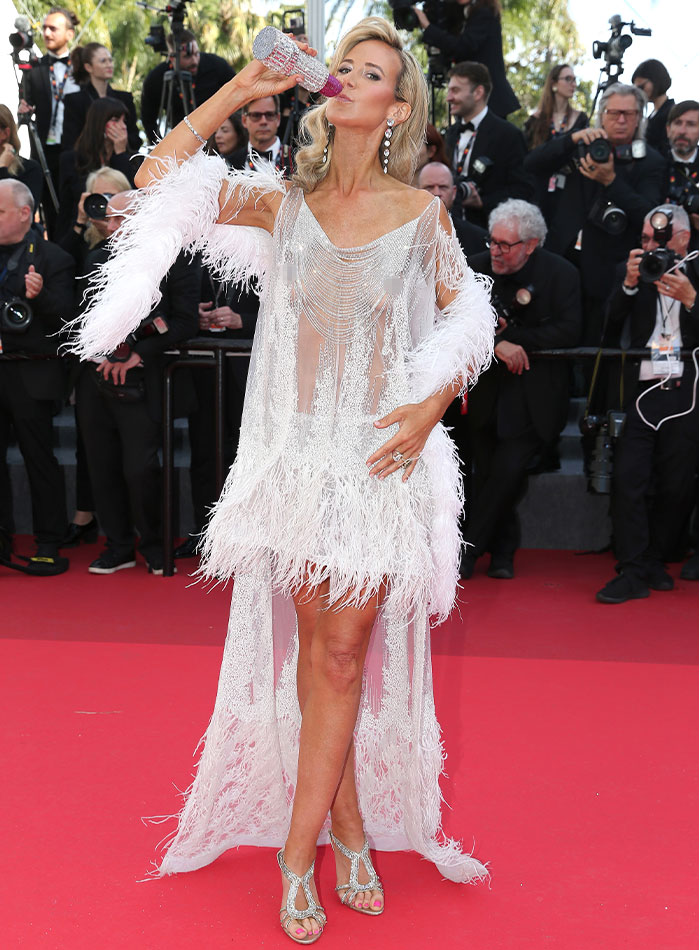
Lady Victoria Hervey turned heads in a revealing feathered mini-dress that appeared to directly challenge the festival’s modesty rules.
The British aristocrat and former early-2000s “It girl,” who is the daughter of the 6th Marquess of Bristol, attended Cannes as a VIP guest, appearing at premieres including La Vie d’une femme (A Woman’s Life) and Fatherland, while also participating in charity events such as The Better World Fund Gala.
However, it was her daytime photocall appearance outside the Hôtel Martinez that quickly became one of the festival’s most talked-about rule-breaking moments.
For the event, Victoria wore a custom white asymmetrical cocktail mini-dress by Madleine Couture, featuring a high neckline, sleeveless silhouette, and completely transparent mesh paneling across the chest, which she wore entirely br*less.
The daring bodice sharply contrasted against the layers of voluminous white ostrich feathers at the bottom, which formed a dramatic skirt.
She paired the ultra-short hemline with metallic silver strappy stilettos featuring reflective heels and delicate ankle wraps.
Because the transparent upper half of the dress was designed to fully expose her breasts, Hervey skipped statement necklaces entirely, accessorizing only with understated diamond stud earrings and a few platinum rings.
Fashion expert Matthew noted that “the body is revealed, but it is also framed through design intelligence. The best sheer dressing creates tension between exposure and concealment.”
Coats also pointed out that “revealing dress can absolutely be self-authored and powerful, but it can also be absorbed into a media economy that rewards visibility, shock and viral circulation,” a dynamic many critics felt surrounded Hervey’s headline-making appearance.
© Photo: Getty/Gisela Schober
#19 Kelly Rutherford
Kelly Rutherford made a striking return to the Cannes red carpet, attending the opening ceremony and the premiere of the French film La Vénus Électrique (The Electric Venus) as a high-profile industry guest and longtime festival regular.
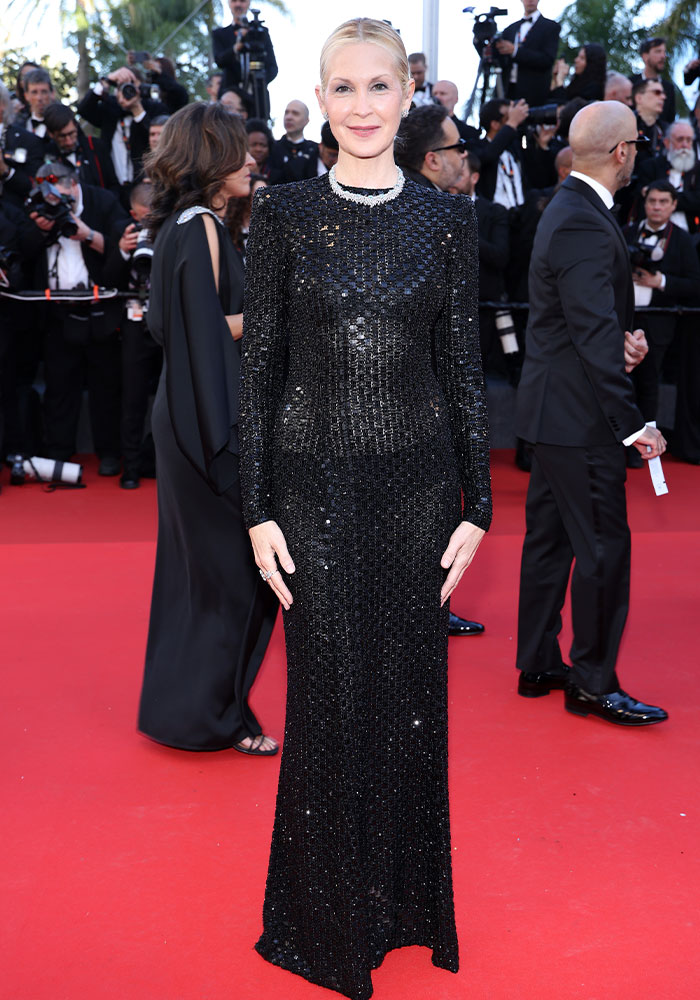
For the premiere, the Gossip Girl alum wore a semi-sheer black sequined Giorgio Armani gown that shimmered under the lights but remained fully transparent from top to bottom.
Instead of opting for subtle under-layering, Rutherford leaned into contrast styling, pairing the look with visible opaque black high-waisted briefs and a matching br*, turning her undergarments into a deliberate part of the outfit.
She completed the look with pointed black heels, a diamond statement necklace accented with pale blue stones, and her signature sleek low bun.
Kelly’s appearance was especially notable given Cannes’ newly reinforced charter discouraging sheer exposure on the red carpet.
While the gown technically maintained coverage, its transparency and styling choices placed it firmly in the gray area of the festival’s evolving rules.
Dr. Naomi observed that “although it is clearly see-through, the worn undergarments ensure there is limited exposure. I think that over the last few years we have had overexposure to the sheer/n*dity look, and it is rather refreshing to see looks that are different.”
“It is a signal of something new happening,” she added.
Her perspective positioned the look less as outright provocation and more as part of a broader shift in red-carpet fashion.
© Photo: Getty/Pascal Le Segretain
Cannes 2026 ultimately emerged as a prime example of how red-carpet fashion continues to evolve under tighter scrutiny.
As Matthew noted, “Cannes is clearly trying to protect a particular idea of prestige: cinema, glamour, ceremony and institutional decorum. But fashion has always tested the boundaries of respectability, and red carpets are never neutral spaces.”
What became clear across this year’s most talked-about looks is that restriction did not eliminate creativity; it redirected it.
Designers leaned into craftsmanship, sculptural tailoring, embroidery, and optical illusion techniques to create impact without relying solely on body exposure.
At the same time, Coats highlighted the underlying tension that remains central to these debates: “The risk is that terms like ‘decency’ are subjective and are often applied more heavily to women’s bodies than to men’s fashion.”
“So while the rules may protect the event’s image, they also raise questions about who gets policed, what kinds of bodies are considered appropriate, and where creativity is allowed to sit.”